|
An Introduction to Learning Styles
© Beverley Paine, Jan 2004
Mention learning styles and everyone seems to know a little about the subject. Many people associate learning styles with left and right brain functioning, and a few will talk about visual or auditory learners. But few people seem to really know what they are talking about, despite readily concurring that knowing your own or your children's learning styles is beneficial and educationally advantageous.
There is still great controversy about the subject of learning styles, even after several decades of research and investigation. Among academics there is little agreement about what learning styles really are. Some claim them to be clearly distinguishable modalities of learning in individuals, but others see them as representative of 'learning differences'. Two major issues have dominated much of the research and discussion on learning styles, the first, whether to teach to students' strengths and expand their learning styles; and the second, whether valid and reliable tests can be devised to determine individual learning styles.
In all of this the emphasis is placed well and truly on improving the academic performance of students in educational institutions, often primary and secondary schools. In many studies on learning styles the purpose of education is defined as "a continuing process - a way of solving problems creatively and planning for the future". However, in home education the purpose of learning is often expanded well beyond mere 'problem solving' or fixated on future goals. Learning has intrinsic worth, and is valued in the immediate moment for what it offers the learner in terms of personal and social growth and development. How does the information gathered on learning styles by educationalists apply to home learning environments, and is it relevant?
In many instances homes already tailor their instructional and educational programs for children in an holistic way, with an emphasis on activity and conversational based learning. The quality of educational opportunity expands enormously with increases in one to one attention and provision of personalised, individual learning programs. With this advantage homeschools almost automatically provide guidance and instruction which include a balance in the generally agreed on 'visual, auditory, haptic and kinesthetic' learning modalities.
This is very similar to what is found in early childhood education settings, such as preschools and child care centres, where curriculum and methods of teaching are usually rich in a variety of learning styles, as the emphasis is deliberately focussed on holistic development. In primary schools, at around age eight, the focus narrows, and students become more sedentary and settle into one educationally preferred modality of learning over all others - visual. Traditionally education has been dominated by text books, worksheets or books, blackboards and lectures, focussed on reading, writing and limited listening skills.
This imbalance is reinforced by assessment, recording and evaluation practices in educational institutions, which rely heavily on written communication, further promoting visual learning over all other forms. Home learning environments often reject the necessity of so much 'paper' recording and assessment, preferring an ongoing continuous flow of information between learner, environment and parent to guide learning programs. This would be impossible to quantify, especially for more than a few children, each day. Despite some attempts, generally resisted, over two decades to introduce alternative assessment systems and educational balance into schools based on knowledge about different learning styles, reliance on visual learning continues dominates in classroom practice. This places at least one third of all students at academic risk.
The tendency to duplicate school methods of instruction and education in the home, especially in the early years of homeschooling, often produces the same results for these disadvantaged students that they faced, or would have faced, in a classroom. There is often an emphasis on visual learning, especially for language and mathematical development. Many parents take children out of school hoping to bring them 'up to grade' level, hoping the increased individualised tutoring alone, using traditional school methods of instruction, will bridge the gap. Sadly many of these children are quite unsuited to this style of learning and continue to experience difficulties.
Eventually most parents realise they cannot teach their children anything until the children are ready to learn, and learn on their own terms, in their own way. When this stage of frustration is reached a breakthrough occurs - parents often discover a book on 'learning disabilities' or 'learning styles', and, at the same time relax on pushing visual learning methods in the homeschool, if only for a short time. Homeschooling suddenly falls into place and becomes much easier - and the child begins to learn with the same enthusiasm and rapidity of the early childhood years.
Often all that is needed is the realisation that each child is an unique individual, one who creates his or her own perception of reality in a very different way to all other children, and especially to the adults who determine the educational programs. Instead of continually trying to fit a particular child into 'one size fits all' educational approach, permission is granted to 'cut the suit to fit the child' - to truly individualise learning opportunities. This begins by observing the child intimately, by noticing how and when the child is engaged fully in learning activities of his or her own creation and volition. And it often means putting aside the traditional view of what constitutes education, and redefining it, taking the 'school' out of education, and by placing 'family', home' and 'community' more fully in central place.
Learning to see the world through a child's eyes is important - but not just their eyes. A person's five senses are fully active all the time (unless there is a disability) and are constructing an image of the physical world, which the child then acts upon, thinking and reflecting, building and reconstructing concepts continuously. In one sense a parent 'has to get into the head' of the child to determine that child's most efficient way to approach a learning task.
In a classroom situation this is impossible, but in the home mothers and fathers, with their intimate knowledge of their children, it is much easier, once the realisation has been made the child doesn't need to learn the same way children do in schools. However, it still isn't an easy task and takes a lot of practice, with parents often needing to bury many old assumptions about how learning occurs along the way. Often parents naturally project their own learning styles and preferences onto their children, or simply 'teach' the way they were, or sometimes weren't, taught, using their own past experiences to guide them. Exorcising these old conditioned behaviours and thought processes often takes time.
The children themselves sometimes lead the way, giving clear indications of the way they learn best. Often it is most noticeable when the child is forced to learn in a particular way that is personally disagreeable or incomprehensible - resistance to learning is exhibited by 'tiredness', declarations of 'boredom', fidgeting and irritability, reluctance or inability to 'settle' or concentrate, and perhaps daydreaming. These are warning signs of a mismatch with learning activity, style or even goal with the child. A child cannot learn until the 'lesson' has become personally meaningful, and is built on previously understood and internalised concepts within the skill or topic. The foundations need to be there, solid and firm, for the next step to proceed.
Contrast the picture of the reluctant learner with the enthused learner - same child, different learning situation. Some promoters of learning style theory believe factors such as context and environment have a profound effect on learning ability. The assumption is that a comfortable child who is not experiencing undue stress will learn more efficiently. The myth that children learn best when quiet, sitting upright at desks, attending to books is dying a slow, lingering death.
Ward and Daley, in their book "Learning to Learn" offer a check list for determining environment and emotional factors that contribute to a productive learning state. These include examining the physical environment: room, furniture, lighting, heating and cooling, noise, aspect and view, equipment; as well as the personal; posture, food and water intake, social needs, feelings, goals and objectives. They go further, emphasising that the quality of the learning environment can dramatically affect learning outcomes. Things like tobacco smoke, radiation and other emissions from computer screens, microwaves and televisions, loud noises or music, the often unnoticed flashing from some fluorescent lights, lack of fresh air, strong smells, 'loud' or bold patterns, excessive background noise, and inadequate sunlight intake coupled with bad diet, poor nutrition, allergies and food intolerances, inadequate water intake, physical tiredness and stress, emotional stress, illness, lack of exercise and low level continuos pain can all have a negative impact on learning.
The antidote to these conditions are all based around common sense and healthy practice, but are often overlooked when discussing children and learning. The tendency to blame the learner for 'not learning' in less than ideal learning environments is still very strong. It is usually fairly easy to redress adverse learning conditions by eliminating and retraining old habits and giving some attention to the physical environment. Quite often increased learning ability can result from simply turning off the television, listening to slower, music with a regular beat softly, opening the windows and letting as much natural light and fresh in as possible, remembering to take regular exercise outside and also eating a nutritionally balanced diet, with wholesome snacks and water always available. These are the basics and make a considerable difference.
Having considered the physical aspects of the learning environment and the learner, another widely recognised important aspect is the inner mental processes. A person's attitude to learning is absolutely crucial to the learning process. It is impossible to learn if the learning task is thought of as impossible to achieve. Positive self talk, a high regard for learning and the learner, realistic expectations and goals, confidence, resilience, acceptance of risk and challenge, respect and trust - all these are conducive to greater learning efficiency and need to be prioritised. Working toward a positive attitude to learning is an ongoing educational goal.
Howard Gardner revolutionised learning style theory with his idea of "multiple intelligences". In reality it is illogical to categorise the mind so simplistically, but it does have considerable merit in helping educators understand the learning process and maximise educational opportunity to fulfil children's potential. It allows parents to value all kinds of learning - not just building on strengths and preferred modalities, but catering to the development of the whole child, by using stronger 'intelligences' to awaken and strengthen weaker ones.
The benefits to learners include the valuing and nurturing of individual differences, offering equal access to learning for all learners, and the renaming of 'learning disabilities' with learning differences, thus empowering disadvantaged learners. This supportive approach then leads to notable improvements in all areas of learning, including retention of skills and knowledge, increased self confidence and self esteem, allowing for better preparation for adult life. At the centre of this approach is a balanced, integrated and comprehensive personalised learning curriculum based on observation and reflection of the child learning.
The characteristics of Gardner's model include seven broad intelligences. Successful learners have flexible and integrated learning styles, utilising all of the seven (or more - researchers have continued to add to Gardner's list of intelligences) and achieving a balance between them. Gardner claims the intelligences are used concurrently and typically complement each other as individuals develop skills or solve problems. Identifying your preferred learning style leads to self awareness, and the ability to select the right learning tools for each individual situation. Although there is usually a tendency to be strong in one or more areas self aware learners work to develop strength in the others.
In a perfectly balanced learning environment where all senses are treated with equal respect a young child will naturally develop in a holistic way. This is easily evidenced as most children will sing and babble quite happily while building sandcastles, always watching out for something interesting to add to the construction or talk about. It is only because society places so much emphasis on language development and communication via printed material that continuing development of many of Gardner's intelligences are arrested or relegated to infrequent exercising.
Gardner classifies the seven intelligences as follows:
Number Smart - Logical/Mathematical Intelligence ; the ability to think conceptually; skills in reasoning, logic and problem solving; exploration of patterns, categories and relationships; experiments and manipulates the environment in a controlled way; wonders about and questions natural events.
People Smart - Interpersonal Intelligence ; thinking and processing by relating, co-operating and communicating with others; showing leadership qualities; intuitive ability to sense feelings and intentions of others; ability to understand people and mediate conflict; organiser, communicator and occasionally manipulative; and is 'street smart' with many friends.
Body Smart - Bodily Kinesthetic Intelligence ; processes knowledge through bodily sensation, with excellent fine and gross motor co-ordination; excellent at mimicking physical mannerisms; very active, sometimes labelled hyperactive, with a need to move around.
Music Smart - Musical/Rhythmic Intelligence ; thinks in sounds, rhythms and patterns; sings, hums and whistles; very responsive to music and likes to perform; appreciative and critical of music and others' musical opinions; sensitive to environmental sounds.
Self Smart - Intrapersonal Intelligence ; skilled in inner focussing, with a deep awareness of inner strengths, weaknesses, feelings, dreams and ideas; displaying a strong personality; reflective and analytical; solitary, requiring private space and time.
Word Smart - Linguistic/Verbal Intelligence ; thinks in words with highly developed auditory skills; enjoys playing with words and sounds in language; great story, anecdote and joke tellers; reads a great deal and likes to write.
Picture Smart - Spacial Visual Intelligence ; thinks in images and pictures, with clear visual images and representations; knows the location of everything; has a fascination for machines and contraptions.
Observation is the key to locating a child's preferred learning style. It is possible to build up a profile of the child over time, preferably using unobtrusive methods, unless the child is old enough to participate fully in the activity and is agreeable. The first aspect to be considered is the environmental, what kind of environment is favoured during successful learning activities. This is followed by consideration of the emotional environment - does the child prefer greater or less structure, more of less responsibility for the task, exhibits persistence, and general state of mind, etc. Social setting is important - does the child work best alone, with an adult or a child, in small or large groups? Temporal considerations, or timing of successful learning activities and outcomes may be an important factor - many children concentrate on tasks in the morning, but some 'peak' at other times during the day. There may be a physiological consideration to take into account, such as disability. Culture plays a large role in the development of the intelligences, as societies value different types of intelligences, and the cultural value placed on tasks often determine the emphasis on attaining certain skills and rejecting of others.
Once a learning style has been determined the role of the educator is to match the methods of instruction to that style, while at the same time recognising that all styles of learning are needed to function productively in society. No one learning style is more important than any other, and it is to the child's advantage to be encouraged to develop a broad range of talents and skills. This is easily done in a home learning environment, with the presentation of material and activities in a way that engages the whole child, all of the learning styles in an environment conducive to success. In a classroom setting this will naturally produce an integrated curriculum where individual subjects are rarely taught in isolation. Again this is the norm for many home learning environments, with topics often pursued in depth for as long as there is interest and in as many ways as the children and parents can think of. Perhaps this is why homeschools tend to be so successful - the natural emphasis on holistic develop practiced so successfully in early childhood is never diminished, but continued to be built on.
It is important to always realise that what works for one child in one situation may not work for another child or even another activity with the same child. This is often overlooked, with 'successful' methods being plied to every subsequent learning situation! Learning is a dynamic process and even individuals change as time passes and experience accumulates. A good educator is always observing the learner watching for subtle changes, and reflecting recognition of those changes in instructional and learning scaffolding processes.
In the home learning environment children are given more space, time, stimulation, love, consideration, access to materials, information and are included in family and individual conversations to a far greater degree than school children are. Learning unfolds in a natural way. Understanding children's individual learning preferences, styles or differences is at the heart of capitalising on this natural learning flow. Basically it is understanding each individual learner, recognising his or her innate gifts and talents, building on them, while at the same time enhancing holistic development through balanced learning opportunities in all areas in supportive learning environments. This has sometimes been called by some homeschoolers as 'conscious parenting'.
Some interesting articles I've come across lately about learning styles:
See also Learning Styles and Preferences.

Was this article helpful? Was it worth $1.00 to you?
Your gift of $1 or more helps to keep this site operating
offering encouragement
and reassurance to families
wanting
better outcomes for their children.
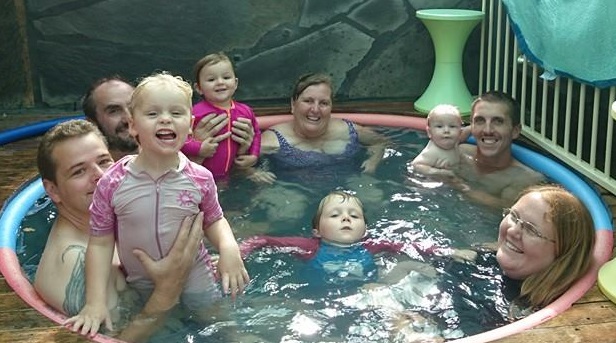
Beverley Paine with her children, and their home educated children, relaxing at home.
Together with the support of my family, my aim is to help parents educate their children in stress-free, nurturing environments. In addition to building and maintaing this website, I continue to create and manage local and national home educating networks, help to organise conferences and camps, as well as write for, edit and produce newsletters, resource directories and magazines. I am an active supporter of national, state, regional and local home education groups.
"You've been an inspiration to me, I love the way
you really listen to people." Vanessa
"Whenever I read your writing I always come away
with increased confidence in my ability to provide and
share a wonderful learning journey with my family!" Davina
"Your guidance, understanding, support and words of
wisdom changed our lives. We now offer support and
organise many homeschooling events for others." Lesley
"Thank you once again for your prompt and friendly service.
I am convinced that your books are going to add
quality and peace of mind to my journey of teaching my kids
at home! Just from studying your website, until almost
2am
in the morning, I 've been encouraged!" Louisa
"Thank you for all your many,many reassuring words
over many, many years. You probably don't know exactly how
valuable you are to the Australian Home Education community.
I've been reading your stuff for maybe 8 years or more now.
And I'm very grateful." Gythaa

CLICK HERE
if you want to learn
how to write your own education plans
to suit
your unique children's
individual learning needs?
Or you are looking for quality curriculum and teaching tips...
|
|
Welcome to the World of Home Education
and Learning without School!
We began educating our children in 1985, when our eldest was five. In truth, we had helped them learn what they need to learn since they were born. I am a passionate advocate of allowing children to learn unhindered by unnecessary stress and competition, meeting developmental needs in ways that suit their individual learning styles and preferences. Ours was a homeschooling, unschooling and natural learning family! There are hundreds of articles on this site to help you build confidence as a home educating family. We hope that your home educating adventure is as satisfying as ours was! Beverley Paine
3 ESSENTIAL STEP BY STEP GUIDES
Let experienced home educators Beverley, Tamara and April walk you through HOW to create a learning plan that builds on solid foundations that works for YOUR family AND ticks all the boxes for home educaton registration!
|

Tap into Beverley's
experience
through her books
"Your books, your blogs helped me beyond words... they helped me to find comfort in knowing it is ok to choose exactly what is best for my family." Nisha
"Your books and information are mind blowing and already I am feeling good about this new experience." Diane
"Your guidance, understanding, support & words of wisdom changed our lives." Leslie
"I feel specially inspired by Beverley's words and, the more I read her comments, the more inspired I feel, since my need for support, respect for different parenting styles, and information are fully met." Marijo
|
 |
|

The information on this website is of a general nature only and is not intended as personal or professional advice. This site merges and incorporates 'Homeschool Australia' and 'Unschool Australia'.
The Educating Parent acknowledges the Traditional Aboriginal and Torres Strait Islander Owners, the Custodians of Australia, and pay our respects to Elders past and present and extend that respect to Aboriginal and Torres Strait Islander people viewing this website.
Advertise on this site.





Australia's premier online annual conferences, lifetime access to video and audio recordings, freebies, notes and associated resource guides.
EVERY SUMMIT IS UNIQUE!
$29 each  2023 2023  2022 2021 2022 2021
$25 each 2020 2019 2017
"Biggest and best Aussie homeschool event of the year!"
Home education is a legal alternative
to school education in Australia.
State and Territory governments are responsible
for regulating home education and have different
requirements, however home educating families
are able to develop curriculum and learning programs
to suit the individual needs of their children.

Without revenue from advertising
by educational suppliers and Google Ads
we could not continue to provide information
to home educators. Please support us by letting
our advertisers know that you found them on
The Educating Parent. Thanks!
|
 About
About


 Thank you for visiting!