|
What Skills Will My Child Learn from Studying Geography?
© Beverley Paine, August 2007
[this article forms part of a series on Geography you can buy as a Practical Homeschooling booklet from Always Learning Books]
Many of the skills we learn from geography we learn from other areas in life, such as asking targetted questions to elicit knowledge and understanding and to solve questions and inform us better about the issues that effect our lives.
Basically, geography a study of place: we find out as much as we can about a location so that we may live in harmony with that enviroment, utilise it's resources sustainably and efficiently, understand how others live there, or why they don't. Our curiosity as to why things are the way that they are helps to solve some of the many problems we may face in our lives. Examining and investigating the possible consequences of alternative courses of action leads to a better understanding of the situation under consideration. Understanding the geography of a location gives us concrete information we can use to devise constructive and sustainable solutions.
Asking questions is a key component of studying geography, as it is in most of the life sciences. Hand-in-hand with questions is speculation: speculating about possible answers gives rise to the development of hypotheses, which in turn, guide the search for information.
There are two types of general questions that are asked in geography: the "where" and "why there" of a problem. Both are important to solving or resolving issues. There are few issues in life which don't have a geographic component, largely because our environment affects us on every level of our being, especially socially.
The aim with teaching and studying geogrpahy is the acquisition of information about different locations, the physical and human characteristics of those locations, and how people use and interact with those places.
Through studying geography children gather information from a a variety of sources using a diverse range of methods, including primary and secondary sources. This enables them to describe, both quantitatively and and qualitatively. This involves collecting data from observation, interviews, questionnaires, fieldwork, collecting samples, reference material, statistics, and library research. The data is then systematically processed and interpreted to support or test a hypothesis in order to present solutions to problems, or to deepen the child's understanding.
Working in the field helps arouse curiosity. It also helps to bring relevance to the task, and makes the study of geography more enjoyable to most children. information can be displayed in ways that make sense and are meaningful both to the task and the child. Data is separated and classified in visual and graphic forms as well as written reports or projects. Visual displays can include photographs, aerial photos, graphs, cross sections, climagraphs, diagrams, tables, cartograms, and maps. Written information can often be presented at tables, spreadsheets, flow chart and time lines. Maps play a central role in geographic inquiry.
It takes skill and creativity to arrange geographic information to effectively communicate issues and solutions to others. These skills are transferrable across the curriculum. Design, color, graphics, scale, and clarity are important factors to determine when developing maps, graphs, charts and other visual presentations that best refelct the data. Presenting information using multi-media technologies is becoming an increasingly important skill to have as one moves into adult life. Choosing the best means of presenting answers to geographic questions is an important skill.
Cartography, or map making, lies at the heart of geography. The ability to read (decode) maps to collect information and analyse patterns and information is central. As children become more familiar with maps they are encouraged to make (encode) maps to organise information. These can be simple 'mud maps' or sketches, made on the spot during field work or to provide instant information. Or they can be complex maps, with legends and symbols relating to resources, landmarks, and other important information. Children need to become familiar with how to find locations using a variety of reference systems, orienting maps and finding directions, and using scales to determine distance.
In addition to organising information, thinking critically is an essential skill developed in the study of geography. Children are born with the ability to think critically and apart from recognising this great innate skill we can help them learn how to enhance and hone their ability. Analysing geographic information involves looking for and identifying patterns. Once patterns are noticed it's easy to begin to see the many relationships that link the various elements. The more connections we see the the easier it is to solve problems, as well as make sense of the world around us.
Interpreting the relationships from the patterns and processes allows us to synthesise the information into coherent explanations. This forms the basis of understanding. From there we can take the next step needed to solving problems and issues. The study of geography encourages children to notice and make associations and similarities between areas as well as recognize patterns, and to draw inferences from maps, graphs, diagrams, tables, and other sources. Using this and other sources of information they can then begin to identify trends, relationships, and sequences.
Through this inquiry based process, using either deductive or inductive reasoning, children arrive at generalisations and conclusions based on the data they have collected, observed and researched and then organised and analysed. As they become proficient geographers they are able to distinguish distinguish generalizations that apply at the local level from those that apply at the global level. These generalisations, backed by the evidence gathered, are used to help them solve problems, make decisions or form judgments.
No other subject impacts on the ability to participate in civil life as much as geography. Clear and effective communication skills, working together with a sound grasp of geogrpahical principles and abilities, enables the young adult to confidently participate in decisions that effect the entire community or nation. Understanding and having empathy for the many points of view, and a desire to explore the many possible outcomes and consequences, when thinking about an issue, is a skill that gradually builds throughout the study of geography.
In summary, it is essential that we help our children to develop the skills that will enable them to observe patterns, associations, and spatial order. This will mean making available and using tools and technologies that are part of the process of geographic inquiry, including maps, satellite-produced images, graphs, sketches, diagrams, photographs as well as charts, graphs, tables, spatial databases and spreadsheets. Geographic information systems make the process of presenting and analysing geographic information easier.
Geography skills will aid our children throughout life in many different ways. It is a relevant and important area of education that our children need regular and frequent exposure to on many levels, from spontaneous and informal learning opportunities to structured lessons and activities. It a wide and exciting subject that deals directly in a meaningful way with the world in which we live and as such is usually of high interest to children.

Was this article helpful? Was it worth $1.00 to you?
Your gift of $1 or more helps to keep this site operating
offering encouragement
and reassurance to families
wanting
better outcomes for their children.
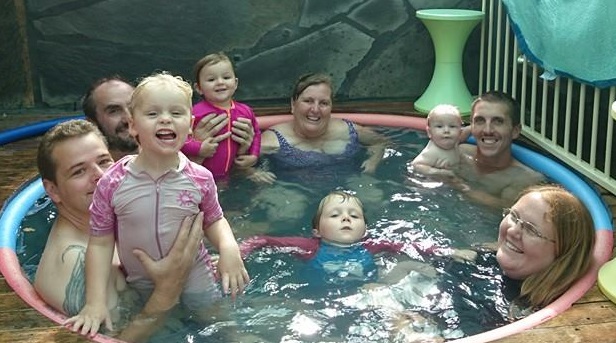
Beverley Paine with her children, and their home educated children, relaxing at home.
Together with the support of my family, my aim is to help parents educate their children in stress-free, nurturing environments. In addition to building and maintaing this website, I continue to create and manage local and national home educating networks, help to organise conferences and camps, as well as write for, edit and produce newsletters, resource directories and magazines. I am an active supporter of national, state, regional and local home education groups.
"You've been an inspiration to me, I love the way
you really listen to people." Vanessa
"Whenever I read your writing I always come away
with increased confidence in my ability to provide and
share a wonderful learning journey with my family!" Davina
"Your guidance, understanding, support and words of
wisdom changed our lives. We now offer support and
organise many homeschooling events for others." Lesley
"Thank you once again for your prompt and friendly service.
I am convinced that your books are going to add
quality and peace of mind to my journey of teaching my kids
at home! Just from studying your website, until almost
2am
in the morning, I 've been encouraged!" Louisa
"Thank you for all your many,many reassuring words
over many, many years. You probably don't know exactly how
valuable you are to the Australian Home Education community.
I've been reading your stuff for maybe 8 years or more now.
And I'm very grateful." Gythaa

CLICK HERE
if you want to learn
how to write your own education plans
to suit
your unique children's
individual learning needs?
Or you are looking for quality curriculum and teaching tips...
|
|
Welcome to the World of Home Education
and Learning without School!
We began educating our children in 1985, when our eldest was five. In truth, we had helped them learn what they need to learn since they were born. I am a passionate advocate of allowing children to learn unhindered by unnecessary stress and competition, meeting developmental needs in ways that suit their individual learning styles and preferences. Ours was a homeschooling, unschooling and natural learning family! There are hundreds of articles on this site to help you build confidence as a home educating family. We hope that your home educating adventure is as satisfying as ours was! Beverley Paine
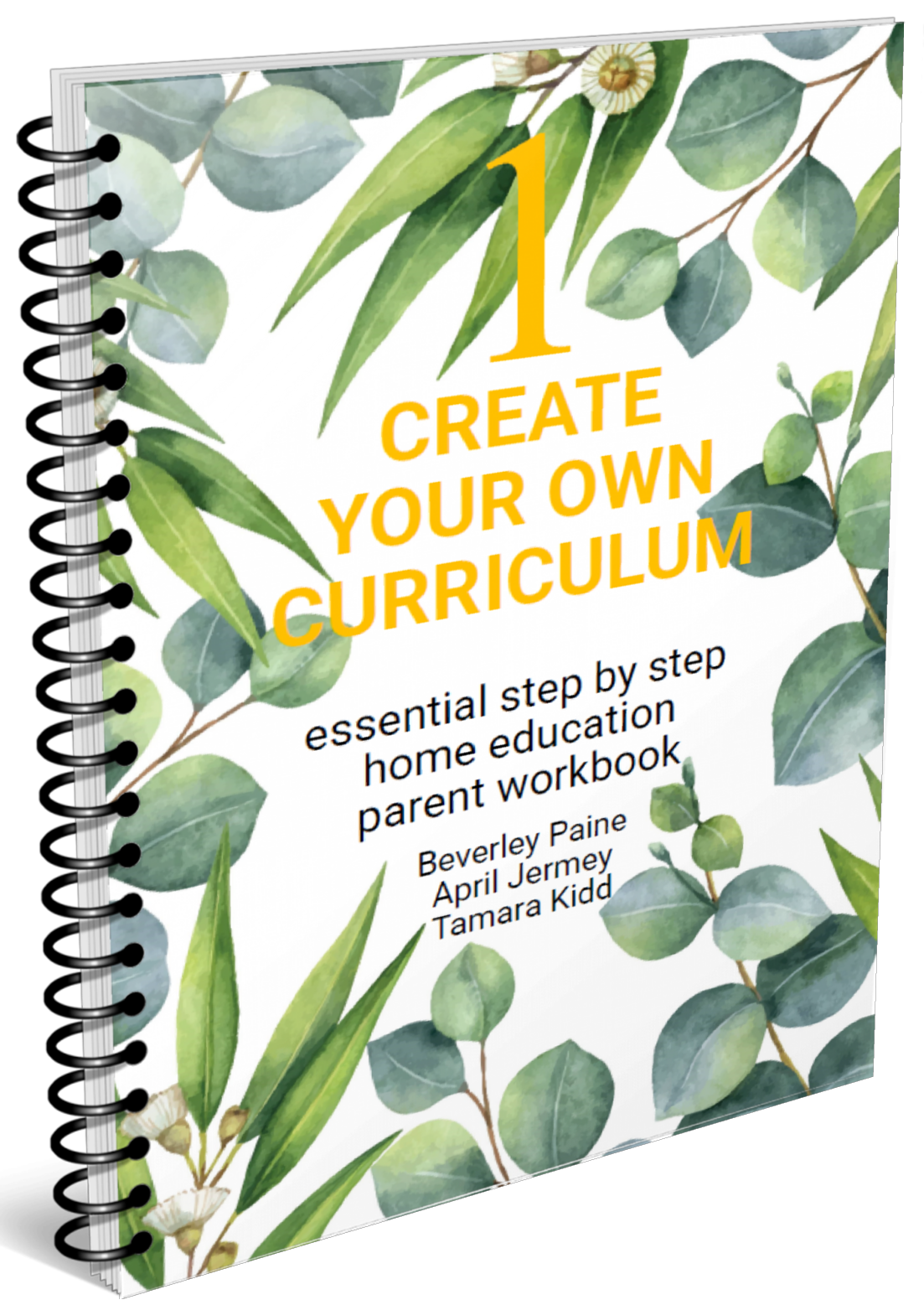
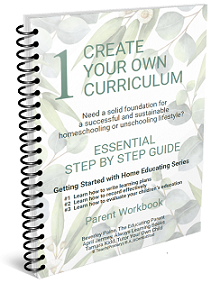
3 ESSENTIAL STEP BY STEP GUIDES
Let experienced home educators Beverley, Tamara and April walk you through HOW to create a learning plan that builds on solid foundations that works for YOUR family AND ticks all the boxes for home educaton registration!
|

Tap into Beverley's
experience
through her books
"Your books, your blogs helped me beyond words... they helped me to find comfort in knowing it is ok to choose exactly what is best for my family." Nisha
"Your books and information are mind blowing and already I am feeling good about this new experience." Diane
"Your guidance, understanding, support & words of wisdom changed our lives." Leslie
"I feel specially inspired by Beverley's words and, the more I read her comments, the more inspired I feel, since my need for support, respect for different parenting styles, and information are fully met." Marijo
|
 |
|

The information on this website is of a general nature only and is not intended as personal or professional advice. This site merges and incorporates 'Homeschool Australia' and 'Unschool Australia'.
The Educating Parent acknowledges the Traditional Aboriginal and Torres Strait Islander Owners, the Custodians of Australia, and pay our respects to Elders past and present and extend that respect to Aboriginal and Torres Strait Islander people viewing this website.
Advertise on this site.





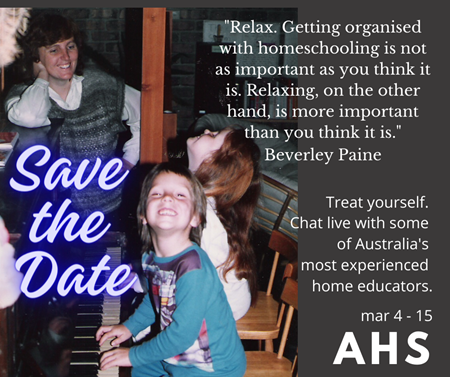
Australia's premier online annual conferences, lifetime access to video and audio recordings, freebies, notes and associated resource guides.
EVERY SUMMIT IS UNIQUE!
$29 each  2023 2023  2022 2021 2022 2021
$25 each 2020 2019 2017
"Biggest and best Aussie homeschool event of the year!"
Home education is a legal alternative
to school education in Australia.
State and Territory governments are responsible
for regulating home education and have different
requirements, however home educating families
are able to develop curriculum and learning programs
to suit the individual needs of their children.

Without revenue from advertising
by educational suppliers and Google Ads
we could not continue to provide information
to home educators. Please support us by letting
our advertisers know that you found them on
The Educating Parent. Thanks!
|
 About
About


 Thank you for visiting!