|
Developing Children's Handwriting: Strategies and Activities
© Beverley Paine
[an excerpt from Developing Children's Handwriting, a Practical Homeschooling Booklet, by Beverley Paine, available from Always Learning Books.]
There are several ways in which you can help your children develop their handwriting
skills. The following are a selection to help you begin thinking about the processes
involved. There is never any ‘right’ way of learning. The more strategies you develop to
help your children learn the more successful they will be.
Present your young children with as many opportunities for tracing, either with their
fingers, arms, pointing sticks, writing utensils, etc. They can trace shapes, pictures,
letters, numbers, symbols, straight or curved lines, etc. As children get older and more
skilled at writing find more complicated and sophisticated tracing activities, such as
maps or mandalas.
You and the child vocalise the movement of the hand, direction, starting place, etc.
when writing or scribing, e.g.
- when I write h, I start at the top, I move the pencil down and then back up,
around and down ;
- to write a c, the pencil starts on the right and moves smoothly up, to the left,
around, down, and then curls up as if it were going to return to the starting point.
Using this type of language has the added bonus of developing spatial mathematical
understanding. You can also use imaginative language - often how you verbally
illustrate the physical processes involved in handwriting will depend on the
individual situation, child or writing purpose.
Encourage your children to discuss and experiment with the feeling and sensation of
movement and position when writing, e.g.:
- write with eyes closed;
- focus eyes on the movement of the writing instrument;
- focus eyes on the movement of the arm, hand or fingers;
- focus eyes on the marks appearing on the writing surface;
- have another person guide arm movement .
Using all of the senses to learn handwriting skills will promote successful outcomes
for all children. Concentrating on visual learning works for some children better than
others, but all benefit from using methods which encourage using all senses.
Children discuss the shape and orientation of letters, and discuss similarities and
differences discovered, e.g.:
Make a ‘handwriting file’ for each of your children and keep it with writing utensils
and different writing media (different colours and grades of paper, card, etc.). You can
direct each child to use the file as the need arises, for practice in specific handwriting
skills. The file could contain:
- examples of a particular handwriting style and practice worksheets;
- pattern cards with basic shapes and patterns for copying;
- tracing cards with tracing paper (or tracing picture books from supermarkets or
newsagents);
- activities to do with examples to copy, e.g. postcards, shopping lists, birthday
and other celebration cards, envelopes for addressing, etc.
Children experiment with different surfaces for writing, e.g.:
- sand
- plastic
- newspaper
- cardboard
- wood
- textured paper
- material
- foil
Children experiment with different handwriting implements, e.g.:
- crayon
- lead pencils or varying softness or hardness
- coloured pencils
- pens, ball point and felt tip
- texta colour
- chalk
- soft rock such as ochre
- stick or twig
- feather
- charcoal
- brush
- pen and ink
Children experiment with different handwriting positions, e.g.:
- at a table
- lying down
- standing
- leaning against a wall
- handwriting surface on left side of body
- handwriting surface on right side of body
Children note aspects of handwriting they find particularly difficult and devise their
own practice activities and opportunities. This could involve practice worksheets,
incorporating words, individual letters, combinations of certain letters, etc. or
providing opportunities to practice handwriting in real tasks or playful tasks. Children
can be encouraged to concentrate of starting places, sizes and directions, etc. according
to purpose and proposed audience.
- Times to be careful
- Letters
- Final drafts
- Posters
- Times to use everyday
- Handwriting style
- Notes
- Writing for myself
- Drafts
Children discuss, and perhaps list, occasions when neatness and presentation are of
prime importance. Your children can use this list to make a personal chart for their
handwriting file for future reference.
Children make autograph books and collect samples of other people’s handwriting.
You could discuss how handwriting styles have changed historically, and compare the
different styles taught in schools this century.
Children can make alphabet books using different handwriting styles, or practice
calligraphy. You could print various fonts from the computer and let the children
practice copying them. Children can add these styles to their charts and suggest and
record appropriate times to use them.
Children can research in various ways handwriting styles and alphabets of other
countries and cultures. They can also research the origins of these, and our own,
alphabet and writing styles.
You can encourage your children to create their own alphabet or code, demonstrating
others that have been used in the past or in literature.
You can provide appropriate models of handwriting styles, presentation, format, etc.
according to the purpose and audience of the writing, e.g.:
- labels for displays
- labels for everyday objects (encourages reading development)
- labels for cupboards, files and boxes
- labels for completed children’s work
- instructions
- posters
- letters
- notes and lists
- recipes
- accounting, budgeting, book-keeping
- completion of forms
- diary or journal
Encourage your children to proof-read and edit their writing, and ask them to consider
the audience and purpose of their writing, especially in relation to:
- legibility
- presentation
- handwriting style
Encourage your children to explore and experiment with the social aspects of
handwriting, e.g.:
- signatures - when and where are they used, developing their own
- greetings - in letters and cards
- map printings
- speed writing for messages and directions
- block printing for completing forms
Encourage your children to experiment with different handwriting movements and
discuss the effects of the different movements on speed, legibility, handwriting style,
etc. Children can practice, e.g.:
- smooth, relaxed movements
- rigid, jerky movements
- finger movements
- hand and arm movements
- different implement grips
- different hands.

Was this article helpful? Was it worth $1.00 to you?
Your gift of $1 or more helps to keep this site operating
offering encouragement
and reassurance to families
wanting
better outcomes for their children.
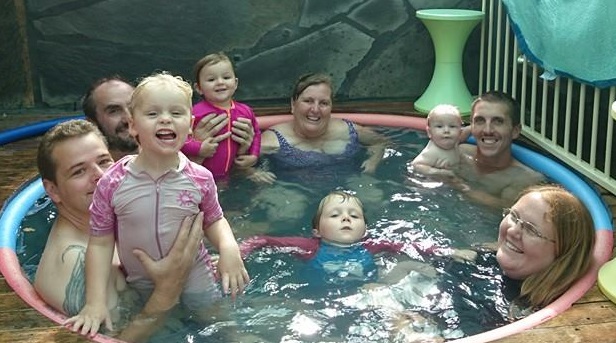
Beverley Paine with her children, and their home educated children, relaxing at home.
Together with the support of my family, my aim is to help parents educate their children in stress-free, nurturing environments. In addition to building and maintaing this website, I continue to create and manage local and national home educating networks, help to organise conferences and camps, as well as write for, edit and produce newsletters, resource directories and magazines. I am an active supporter of national, state, regional and local home education groups.
"You've been an inspiration to me, I love the way
you really listen to people." Vanessa
"Whenever I read your writing I always come away
with increased confidence in my ability to provide and
share a wonderful learning journey with my family!" Davina
"Your guidance, understanding, support and words of
wisdom changed our lives. We now offer support and
organise many homeschooling events for others." Lesley
"Thank you once again for your prompt and friendly service.
I am convinced that your books are going to add
quality and peace of mind to my journey of teaching my kids
at home! Just from studying your website, until almost
2am
in the morning, I 've been encouraged!" Louisa
"Thank you for all your many,many reassuring words
over many, many years. You probably don't know exactly how
valuable you are to the Australian Home Education community.
I've been reading your stuff for maybe 8 years or more now.
And I'm very grateful." Gythaa

CLICK HERE
if you want to learn
how to write your own education plans
to suit
your unique children's
individual learning needs?
Or you are looking for quality curriculum and teaching tips...
|
|
Welcome to the World of Home Education
and Learning without School!
We began educating our children in 1985, when our eldest was five. In truth, we had helped them learn what they need to learn since they were born. I am a passionate advocate of allowing children to learn unhindered by unnecessary stress and competition, meeting developmental needs in ways that suit their individual learning styles and preferences. Ours was a homeschooling, unschooling and natural learning family! There are hundreds of articles on this site to help you build confidence as a home educating family. We hope that your home educating adventure is as satisfying as ours was! Beverley Paine
3 ESSENTIAL STEP BY STEP GUIDES
Let experienced home educators Beverley, Tamara and April walk you through HOW to create a learning plan that builds on solid foundations that works for YOUR family AND ticks all the boxes for home educaton registration!
|

Tap into Beverley's
experience
through her books
"Your books, your blogs helped me beyond words... they helped me to find comfort in knowing it is ok to choose exactly what is best for my family." Nisha
"Your books and information are mind blowing and already I am feeling good about this new experience." Diane
"Your guidance, understanding, support & words of wisdom changed our lives." Leslie
"I feel specially inspired by Beverley's words and, the more I read her comments, the more inspired I feel, since my need for support, respect for different parenting styles, and information are fully met." Marijo
|
 |
|

The information on this website is of a general nature only and is not intended as personal or professional advice. This site merges and incorporates 'Homeschool Australia' and 'Unschool Australia'.
The Educating Parent acknowledges the Traditional Aboriginal and Torres Strait Islander Owners, the Custodians of Australia, and pay our respects to Elders past and present and extend that respect to Aboriginal and Torres Strait Islander people viewing this website.
Advertise on this site.








Australia's premier online annual conferences, lifetime access to video and audio recordings, freebies, notes and associated resource guides.
EVERY SUMMIT IS UNIQUE!
$29 each  2023 2023  2022 2021 2022 2021
$25 each 2020 2019 2017
"Biggest and best Aussie homeschool event of the year!"
Home education is a legal alternative
to school education in Australia.
State and Territory governments are responsible
for regulating home education and have different
requirements, however home educating families
are able to develop curriculum and learning programs
to suit the individual needs of their children.

Without revenue from advertising
by educational suppliers and Google Ads
we could not continue to provide information
to home educators. Please support us by letting
our advertisers know that you found them on
The Educating Parent. Thanks!
|
 About
About


 Thank you for visiting!